
Why Software Projects Run Over Budget, and How Disciplined Planning Prevents It
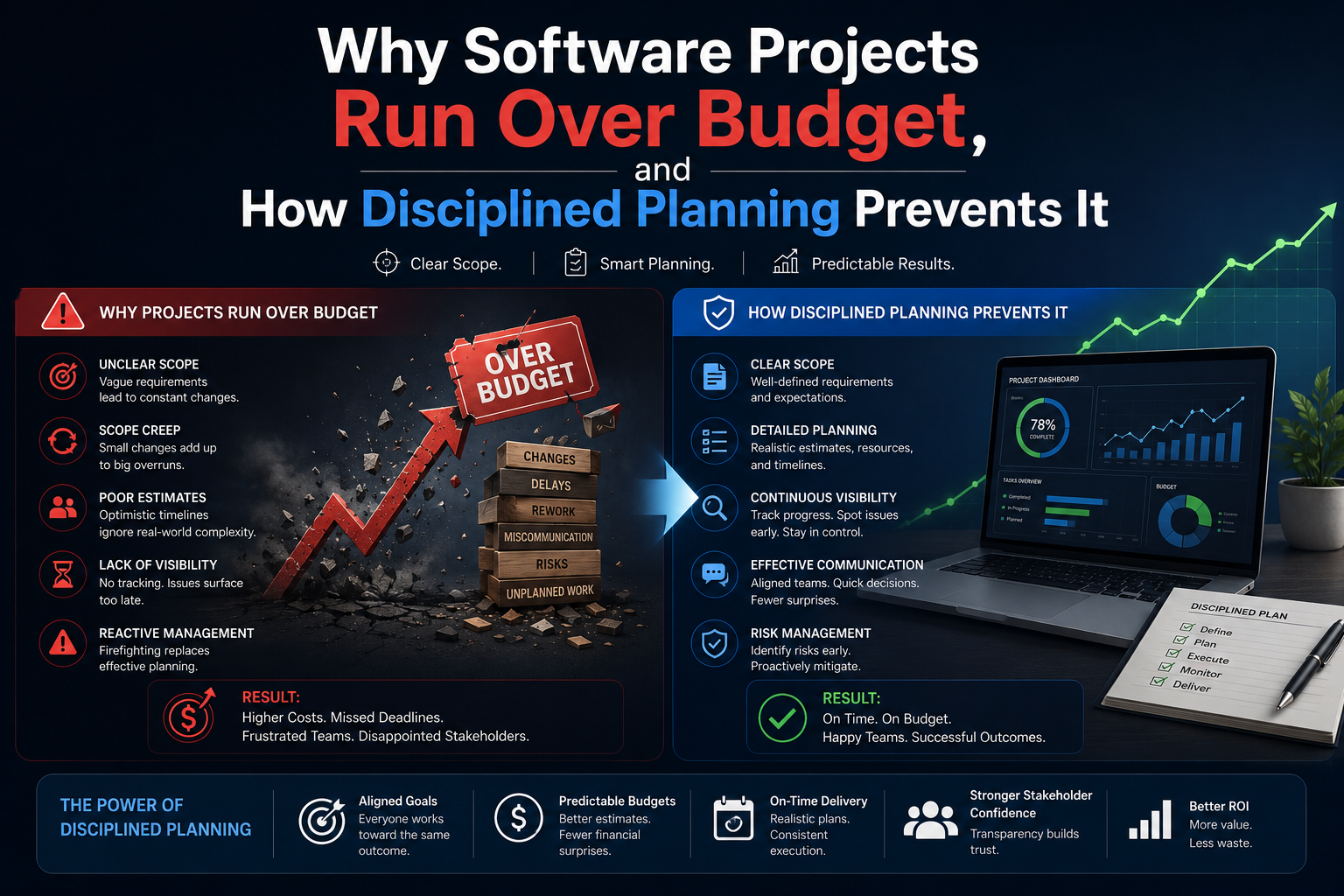
Almost every software project that runs over budget does so for the same handful of reasons, and almost none of them are the reason most people assume. It is rarely that developers are slow. It is usually that the project was scoped loosely, communicated poorly, or both.
Scope That Was Never Actually Fixed
The most common driver of budget overruns is a scope that looked fixed on paper but was never truly agreed on in detail. "Build a client portal" is not a scope, it is a direction. Without a clear list of what is in and out of the first release, every reasonable-sounding addition during development quietly expands the project, and each one feels small in isolation.
Decisions Made Too Late
Projects lose money when key decisions, about design, integrations, or data structure, get made after development has already started rather than before. Revisiting a decision after code has been built around it is always more expensive than making the right call earlier, even if earlier means slowing down to ask harder questions upfront.
Underestimating Integration Work
Connecting to a payment gateway, an existing CRM, or a legacy database almost always takes longer than the surface-level estimate suggests, because the real complexity is in the edge cases and inconsistent data on the other side of that integration, not in the integration code itself.
No Clear Definition of "Done"
Without a specific, written definition of what a finished feature looks like, "done" becomes a moving target. Developers build something reasonable, stakeholders see it and want adjustments, and that cycle repeats indefinitely without ever being technically over budget on any single task, while the project as a whole drifts later and later.
What Disciplined Planning Actually Looks Like
The projects that stay on budget share a few specific habits. They lock a detailed scope before development starts, not just a one-line description. They make architecture and integration decisions early, even if that means a slower start. They define what "done" means for each feature in concrete terms before work begins. And they treat any new request mid-project as a deliberate, priced decision rather than something quietly absorbed into the existing timeline.
A budget rarely fails because the work was harder than expected. It fails because the agreement about what the work actually included was never specific enough to hold.
Good planning is not slower than rushing in. It is usually the difference between a project that finishes close to its original estimate and one that does not.