Beyond Chatbots: How AI Agents Are Redefining Marketing Automation
For years, the digital marketing landscape relied heavily on rule-based automation. We scheduled social campaigns, set up rudimentary auto-responders, and triggered linear email sequences based on simple user clicks. But over the past year, the industry has reached a defining inflection point. We are moving rapidly past reactive bots and stepping squarely into the era of autonomous, agent-driven growth engines.
At Infovative Technology Solutions, analyzing how emerging digital ecosystems evolve is central to our mission. As businesses push to scale in an increasingly fragmented digital arena, the shift from traditional automation to multi-agent architecture represents a total paradigm shift in how growth pipelines are built and maintained.
The Evolution of Digital Growth
When we examine how marketing technology has matured, the most significant leap has been the transition from static, scripted workflows to continuous, real-time feedback loops. In older marketing stacks, automation was brittle. If a lead took an unexpected path outside a pre-configured branch, the sequence broke. Customer profiles remained trapped in siloed dashboards, requiring continuous manual auditing and constant campaign re-adjustments.
Today, the underlying architecture of digital marketing relies on dynamic orchestration. Modern AI systems don't wait for rigid manual triggers. Instead, advanced model inference and automated pipelines allow platforms to evaluate consumer behavior in milliseconds, dynamically adjust paid ad distribution, and personalize customer touchpoints without requiring continuous manual campaign engineering.
The Role of AI Agents in Modern Marketing
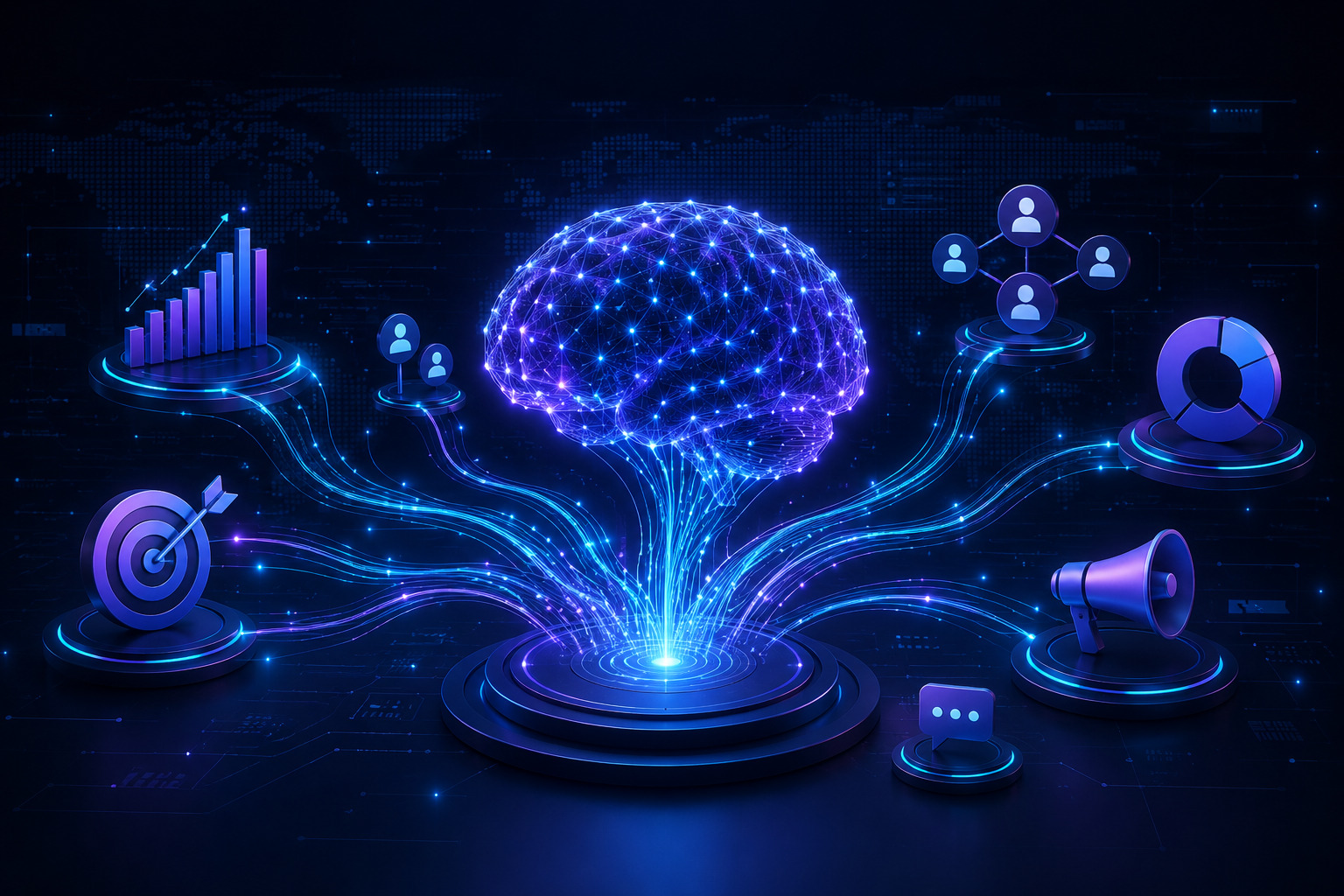
When people hear "Artificial Intelligence" in a marketing context, they often default to Generative AI—such as using LLMs to draft social captions or generate creative imagery. However, forward-thinking growth teams are deploying Agentic AI: autonomous systems designed to perceive environments, reason through multi-step objectives, and execute complex workflows independently.
-
Dynamic Predictive Segmentation: Rather than manually defining broad audience segments, AI agents parse high-volume interaction data to discover hidden conversion patterns. They segment audiences on a micro-level in real-time, matching specific creatives to user intent before a prospect even enters the primary conversion funnel.
-
Autonomous Campaign Optimization: These agents operate on advanced decision engines. Instead of simply pushing an ad budget on a static schedule, an agent continuously evaluates market factors—fluctuating ad auctions, real-time engagement patterns, competitor maneuvers, and seasonal demand—autonomously tuning campaign parameters to protect CAC (Customer Acquisition Cost).
The "Growth" Input: Autonomous Scaling Frameworks
Under the hood, integrating AI Agents transforms standard marketing funnels into resilient, self-healing growth machines. The technical advantages for digital strategists and modern brands are substantial:
-
Multi-Modal Dynamic Personalization: Every user interaction triggers a bespoke response calculated on the fly. Rather than displaying generic banner creatives or templated landing pages, an AI agent coordinates asset assembly in real-time—tailoring visual elements, value propositions, and calls-to-action to match an individual's browsing footprint.
-
Autonomous Cross-Channel Synergy: Modern buyers move across channels erratically. An agentic marketing layer integrates touchpoints across Google, Meta, email, and direct web interactions simultaneously. An action taken on LinkedIn immediately informs how an agent optimizes conversion pathways on your web platform, eliminating broken attribution.
-
Predictive Lifetime Value (LTV) Modeling: Moving beyond vanity traffic metrics, agents continuously calculate the lifetime yield of incoming cohorts. By mapping attribution data against customer retention, the system systematically allocates capital toward the traffic sources that yield sustainable revenue.
As digital markets grow noisier and acquisition costs rise, the real competitive edge will not belong to those who merely produce more content. It will belong to brands that deploy intelligent, self-optimizing ecosystems capable of learning and adapting around the clock. For growth leaders and businesses looking ahead, AI agents are establishing the definitive benchmark for the next decade of digital marketing.