Custom Software vs. Off-the-Shelf: What Growing Businesses Get Wrong
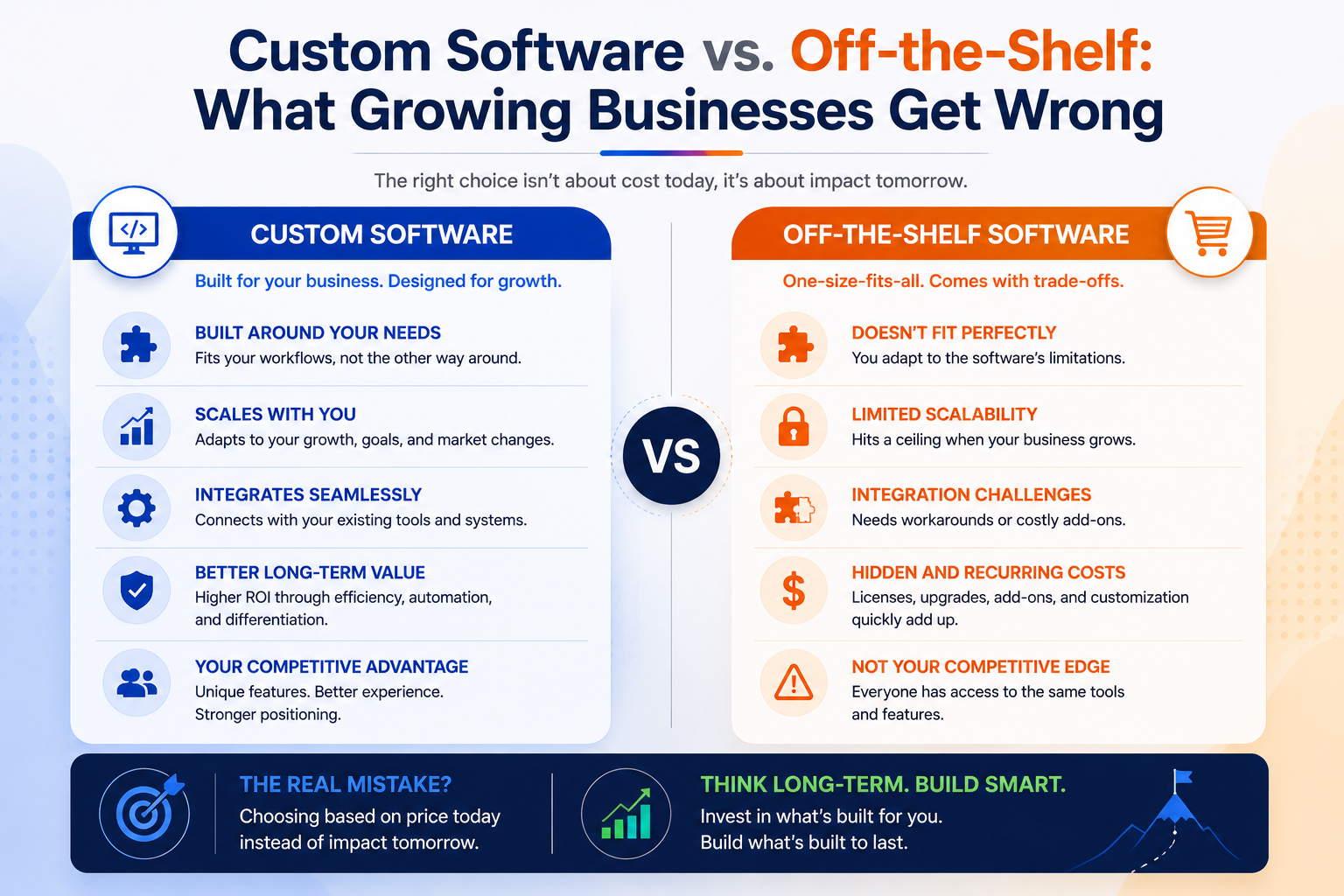
Every growing business eventually faces this decision: keep stitching together off-the-shelf tools, or invest in something built specifically for how you work. Neither answer is automatically right. Here is how to actually think it through.
When Off-the-Shelf Is the Better Call
Off-the-shelf software exists because most business problems are not unique. If your need is generic, paying to rebuild it from scratch is usually a waste of money. Off-the-shelf makes sense when:
- Your workflow is close to industry-standard, with no unusual exceptions or edge cases
- Speed matters more than a perfect fit; you need something working this month, not in three months
- The tool's limitations do not actually block anything important to your business
When Custom Software Actually Pays Off
Custom software earns its cost when the gap between "what generic tools offer" and "what your business actually needs" is wide enough that you are paying for it anyway, just less visibly. That shows up as:
- Workarounds everywhere: If your team has built a maze of spreadsheets and manual steps around a tool's limitations, you are already paying the cost of a custom solution, just in lost time instead of money.
- Your workflow is the differentiator: If how you operate is part of what makes your business competitive, forcing that into generic software flattens your advantage.
- You are paying for features you do not use, while missing ones you need: A common pattern with all-in-one SaaS platforms once a business outgrows the default use case.
- Data lives in too many disconnected places: Off-the-shelf tools rarely talk to each other well. A custom system can be built around your actual data flow instead of around the boundaries of five different subscriptions.
The Middle Path Most Businesses Miss
It is rarely all-or-nothing. Many businesses get the best outcome from a hybrid approach: keep off-the-shelf tools for genuinely generic functions like email or accounting, and invest in custom software specifically for the workflows that are core to how the business actually makes money or serves clients.
The real question is not "custom or off-the-shelf," it is "which parts of my business are generic, and which parts are actually my competitive edge."
A Quick Gut Check
If you are still unsure, ask: "If a competitor used the exact same off-the-shelf setup as us, would it matter?" If the answer is no, off-the-shelf is probably fine. If the answer is yes, that is usually a sign you are looking at a part of the business worth building for, on purpose.