
AI and Supercomputers
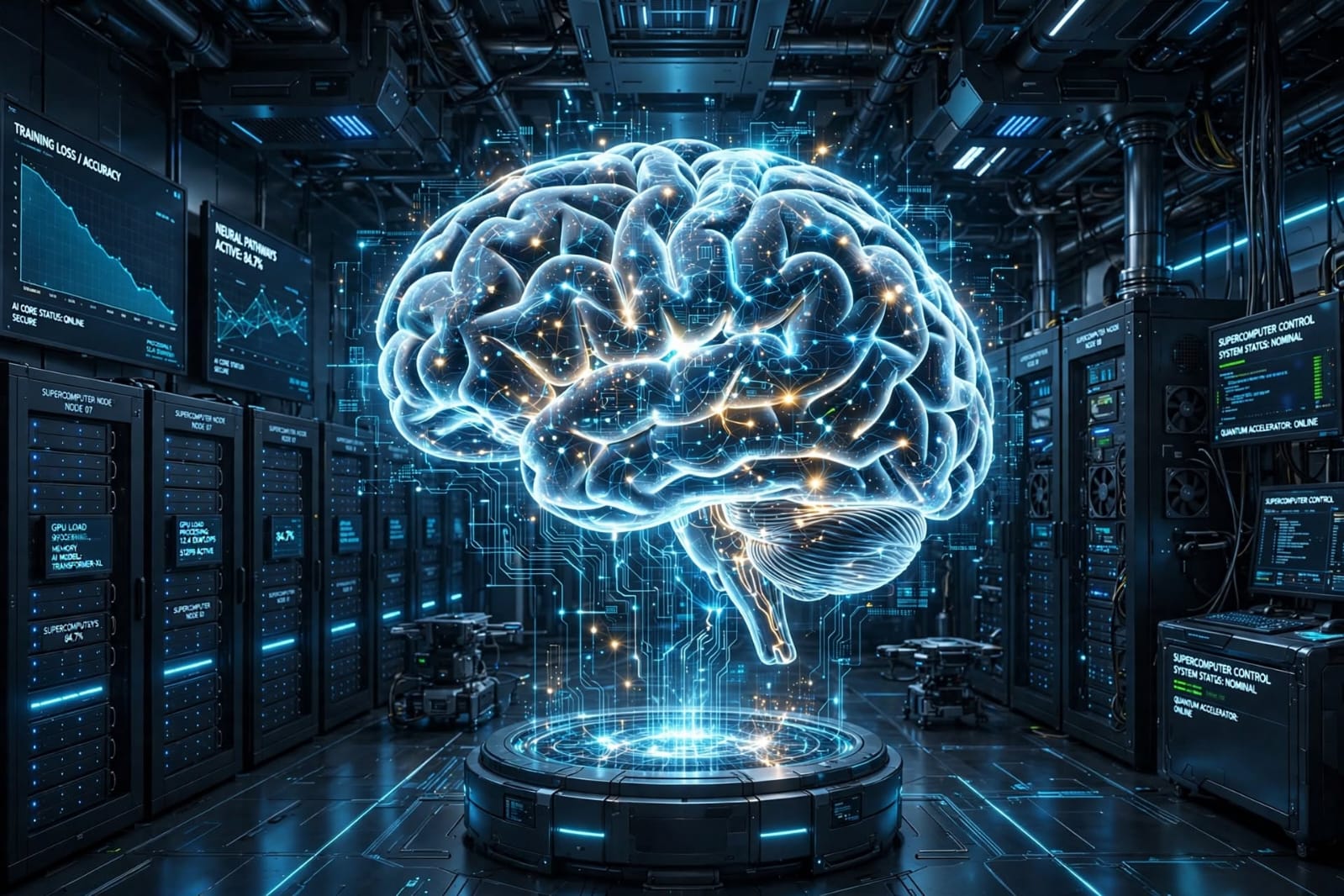
AI and Supercomputers: The Engine Behind Intelligence
We tend to think of Artificial Intelligence as software — invisible code running in the cloud. But behind every ChatGPT response, every medical diagnosis, every self-driving car decision, there is brute-force physical power. That power comes from supercomputers. AI and supercomputers are no longer two separate fields; they are a single, co-evolving system.
Why AI Needs Supercomputers?
Training a modern AI model is not like writing a normal program. It is like teaching a brain from scratch by showing it the entire internet.
A large language model like GPT-4 or Claude 3 doesn't learn rules. It learns patterns from trillions of words, images, and data points. To do that, it must perform quintillions of mathematical operations — matrix multiplications, gradient calculations, weight updates — over and over for weeks or months.
Your laptop can do perhaps a few trillion operations per second (teraflops). A frontier AI training run needs exaflops — a quintillion operations per second — sustained for 60 to 90 days. Without supercomputers, this would take centuries.
This is why the history of AI breakthroughs is really a history of computing hardware. The deep learning revolution of 2012 only happened because researchers started using GPUs. The generative AI revolution of 2023 only happened because companies built supercomputers with tens of thousands of GPUs working in parallel.
How Supercomputers Are Built for AI:
Traditional supercomputers were built for physics simulations — weather forecasting, nuclear modeling. They were optimized for high-precision calculations and complex interconnections between CPUs.
AI supercomputers are architecturally different. They are optimized for three things:
1.Massive Parallelism:
Instead of a few powerful CPUs, they use tens of thousands of accelerators. NVIDIA's H100, AMD's MI300X, or Google's TPUs are designed to do thousands of low-precision calculations at once — perfect for neural networks. Systems like Microsoft's Eagle, which trained GPT-4, contain over 25,000 GPUs connected as one computer.
2. Insane Bandwidth:
In AI training, moving data is often slower than computing it. AI supercomputers use ultra-fast interconnects like NVIDIA NVLink and InfiniBand to let GPUs share memory at up to 900 gigabytes per second. If one GPU falls behind, the whole training run stalls.
3. Resilience and Software:
A supercomputer with 20,000 GPUs will have hardware failures every few hours. Modern AI stacks — like NVIDIA's NCCL, PyTorch Distributed, and checkpointing systems — are built to save progress every few minutes and reroute work automatically. The supercomputer must act like a single, unbreakable brain.
Today's most powerful machines blur the line. Frontier at Oak Ridge National Laboratory, the world's first exascale supercomputer, was built for science but now spends a large portion of its time training AI models for climate prediction and protein folding.
What This Partnership Unlocks
When you combine AI with supercomputing, you get capabilities neither could achieve alone:
Science at Superhuman Speed: DeepMind's AlphaFold used supercomputing to predict the structure of 200 million proteins — work that would have taken biologists a billion years in the lab. Now researchers are using similar systems to design new materials, batteries, and drugs in days.
Climate and Weather: Google's GraphCast, trained on decades of weather data on supercomputers, can predict a 10-day global forecast in under a minute, with higher accuracy than traditional physics models that take hours on a supercomputer.
Personalized Intelligence: Every time you ask an AI assistant a question, the model is not retraining — it is running inference. That also requires supercomputer-grade clusters distributed worldwide to answer billions of requests with low latency.
In essence, supercomputers build the intelligence, and supercomputers deliver it.
The Next Frontier
We are hitting two limits.
The first is energy. Training a single frontier model can consume 20-50 gigawatt-hours — enough to power 5,000 American homes for a year. The next generation of supercomputers is being co-designed with power grids, using liquid cooling, custom silicon, and even nuclear-adjacent power sources.
The second is architecture. The future is not just bigger GPU clusters. We are seeing the rise of AI-native supercomputers — systems like Cerebras wafer-scale engines where the entire chip is one giant processor, or neuromorphic systems that mimic how neurons fire.
The race is no longer about who has the smartest algorithm. Every lab has similar algorithms. The race is about who can build and sustain the most powerful, efficient, and intelligent supercomputer.
AI gave supercomputers a purpose beyond simulation. Supercomputers gave AI a body to grow in. Together, they are becoming the most powerful tool for understanding and shaping our world