The Local AI Revolution: Breaking Free from the Cloud with Llama, Qwen, and DeepSeek
For the past several years, the prevailing consensus across the tech industry was straightforward: state-of-the-art artificial intelligence lived exclusively behind cloud paywalls. If an organization wanted frontier-level reasoning, it had to accept the terms of the hyperscalers. That meant paying recurring per-token fees, accepting API latency fluctuations, and transmitting proprietary codebases and confidential business records to remote servers.
That dynamic is undergoing a rapid, structural inversion. The gap between proprietary flagships like Claude or GPT models and the open-weight ecosystem has largely evaporated. The arrival of high-efficiency architectures has turned local AI from an enthusiast workaround into a viable enterprise strategy. Teams no longer need to choose between intelligence and ownership; they can have both directly on their own hardware.
The Rise of Frontier-Grade Open Weights
The modern open-source landscape is no longer playing catch-up; it is setting the pace of specialization.
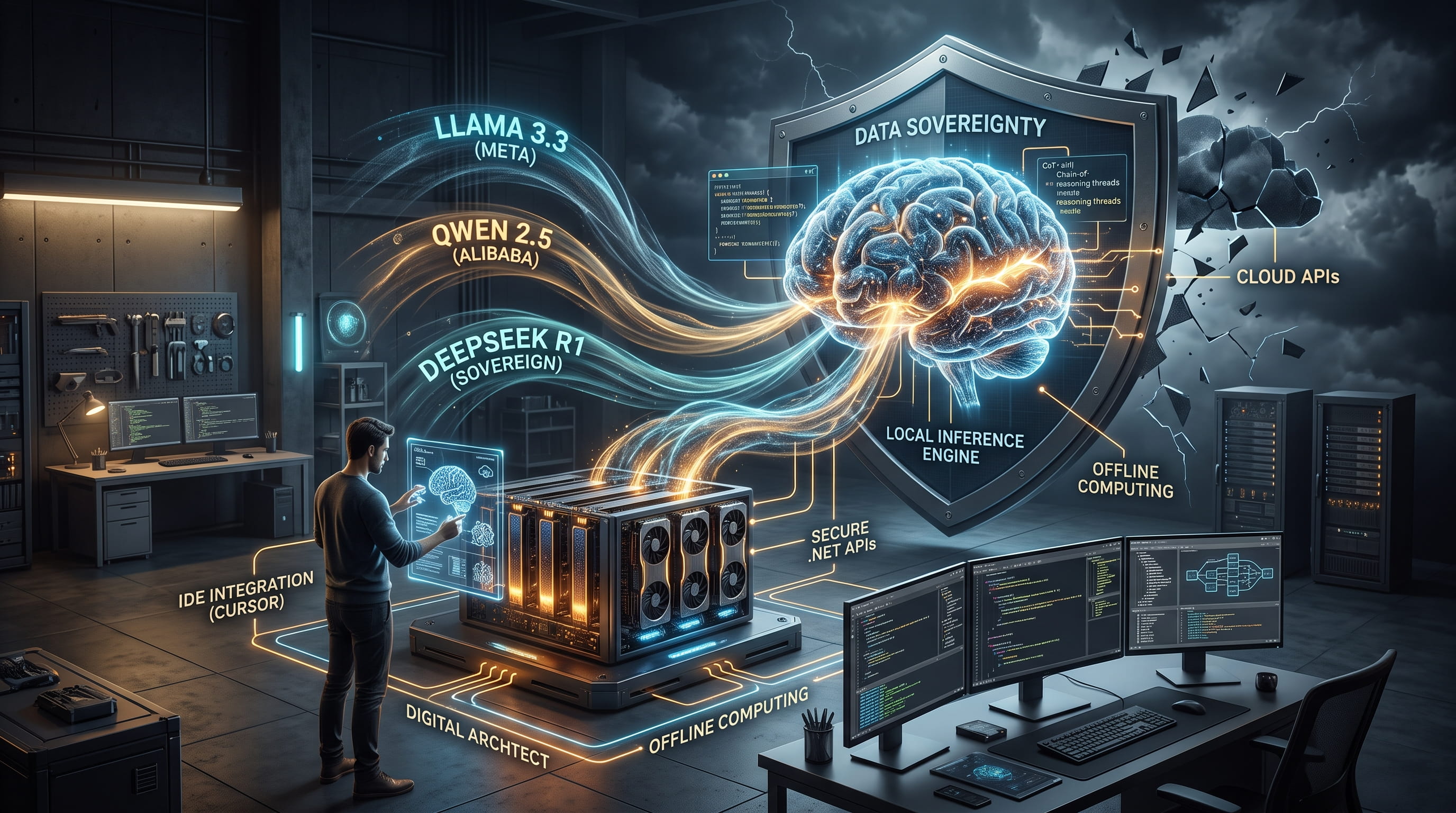
Meta's Llama series, culminating in models like Llama 3.3, redefined what open weights could achieve. The 70B parameter variant delivers the depth of reasoning, nuanced conversational tone, and context processing previously reserved for multi-million-dollar proprietary APIs. It serves as an uncompromising general-purpose brain for organizations looking to self-host their intelligence operations.
Simultaneously, specialized players have carved out undeniable dominance in critical technical domains. Alibaba’s Qwen 2.5 series—particularly Qwen 2.5-Coder—has become an essential powerhouse for software engineering teams. Its precision in syntax generation, deep comprehension of architectural patterns across stacks like .NET and modern JavaScript, and rapid refactoring capabilities match or exceed commercial coding copilots.
Meanwhile, DeepSeek disrupted conventional industry thinking around algorithmic reasoning. By demonstrating that sophisticated Chain-of-Thought (CoT) problem-solving could be achieved at a fraction of the traditional training compute, models like DeepSeek R1 proved that mathematical modeling, logical auditing, and complex multi-variable analysis are entirely feasible outside the big-tech walled gardens.
The Engineering Breakthrough: Why Consumer Hardware Works
The traditional barrier to running large language models locally was raw memory footprint. Storing billions of 16-bit floating-point parameters required specialized data center cards with immense memory capacities.
The turning point came with the maturation of post-training quantization techniques. By packaging models into optimized 4-bit and 8-bit formats (such as GGUF), engineers managed to reduce memory overhead by upwards of 70% while sacrificing negligible reasoning accuracy.
A high-capability 8B or 14B model can run comfortably on standard consumer GPUs with 8GB to 16GB of VRAM, delivering real-time token throughput suitable for IDE completions and immediate chat interfaces. For mid-range models in the 32B bracket, desktop workstations equipped with modern graphics cards easily handle the load.
Even more transformative has been the emergence of unified memory architectures found in modern personal hardware, particularly Apple Silicon. By sharing a high-speed memory pool between the CPU and graphics cores, workstations equipped with 64GB or 128GB of unified memory can run massive 70B parameter models natively. The need for specialized liquid-cooled server racks has given way to powerful desktop workstations sitting quietly on an engineer's desk.
The Infrastructure: Engines That Power the Shift
The hardware, however, is only as effective as the runtime orchestrating it. The friction of configuring complex Python environments, CUDA drivers, and manual tensor libraries has been abstracted away by modern execution frameworks.
Ollama has emerged as the de facto engine for local compute, operating as a lightweight background daemon that treats neural networks with the ease of containerized software. Beyond providing seamless terminal execution, it automatically exposes standard REST endpoints compatible with conventional OpenAI specifications. This allows modern IDEs, automated continuous integration pipelines, and custom enterprise backends to route requests directly to internal silicon without altering application logic.
For workflows demanding graphical control, environments like LM Studio offer intuitive model management, hardware-level diagnostic tracking, and direct Hugging Face integration, providing immediate visual validation before rolling models into automated internal pipelines.
The Strategic Imperative: Data Sovereignty and Economic Predictability
While the technical novelty of running an AI model offline is appealing, the true driver of this shift is strategic business advantage.
The primary incentive is absolute data sovereignty. For organizations operating in sensitive domains—whether dealing with proprietary IP, legal records, or confidential client communications—sending data outside internal perimeter walls presents real compliance and governance friction. Running an inference engine locally ensures zero telemetry, zero third-party retention, and zero risk of proprietary business logic being ingested into external training corpora.
The secondary incentive is operational predictability. Cloud-based APIs introduce variable operational expenses that expand proportionally with user adoption and automation frequency. A sudden spike in background agent tasks or high-throughput batch processing can translate into unexpected invoices. Local AI operates on fixed, sunk hardware costs. Once an internal inference server or workstation is provisioned, the cost of processing a billion tokens is simply the electricity needed to power the wall outlet.
The centralization of AI into a handful of closed cloud environments was an initial phase of technological discovery. The future of intelligence is distributed, sovereign, and hosted where the work actually happens.